
PENGUIN: General Vital Sign Reconstruction from PPG
PENGUIN is a generative model developed by Neurogica that reconstructs vital sign waveforms from photoplethysmography (PPG). It was accepted at ICASSP 2026, a top conference in signal processing. Evaluated on three tasks — electrocardiogram (ECG), respiration and arterial blood pressure (ABP) — across six real-world datasets, it achieved the best accuracy on 7 of 8 metrics.
Why PPG
PPG measures changes in blood flow with light. It works from the wrist or a fingertip and is already built into smartwatches and smart rings. Because it is non-invasive and inexpensive, it is a strong candidate for continuous, everyday cardiovascular monitoring.
The difficulty is that PPG is highly susceptible to motion artifacts and noise, which makes estimating vital signs such as blood pressure from it hard. Most existing methods are tailored to a single task or environment. Recent models that handle multiple vital signs mostly predict discrete values at multi-second intervals, discarding the shape of the waveform itself — even though the shape, such as the sharp peaks of an ECG or the amplitude of a blood-pressure wave, carries clinically important information.
How PENGUIN works
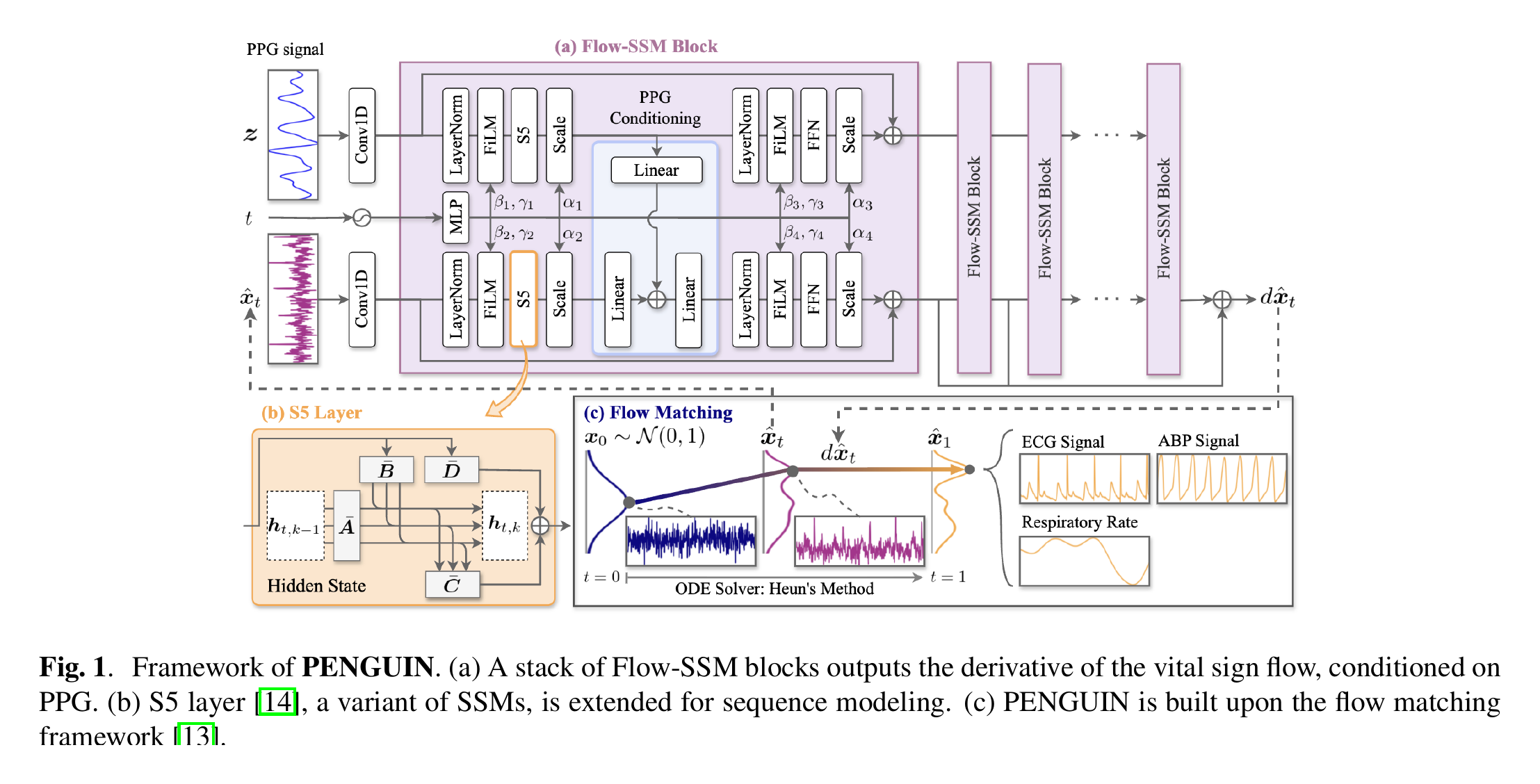
PENGUIN builds on flow matching, a generative framework that learns a transport path from noise to the target waveform, and extends S5, a state space model suited to long sequences. Two mechanisms are central.
Generate waveforms as waveforms. Instead of a sequence of numbers, the model generates the continuous waveform itself, preserving shape information such as the sharpness of QRS complexes, respiratory rhythm and blood-pressure amplitude. Flow matching keeps generation high-quality with only a few sampling steps.
Condition on PPG at every timestep. A dual-stream Flow-SSM block processes PPG and the vital sign in parallel and adds the PPG features directly to the output at each timestep. Because the two signals are temporally aligned — the systolic peak in PPG corresponds to the R-peak in ECG — this per-timestep conditioning captures their correspondence precisely.
Results
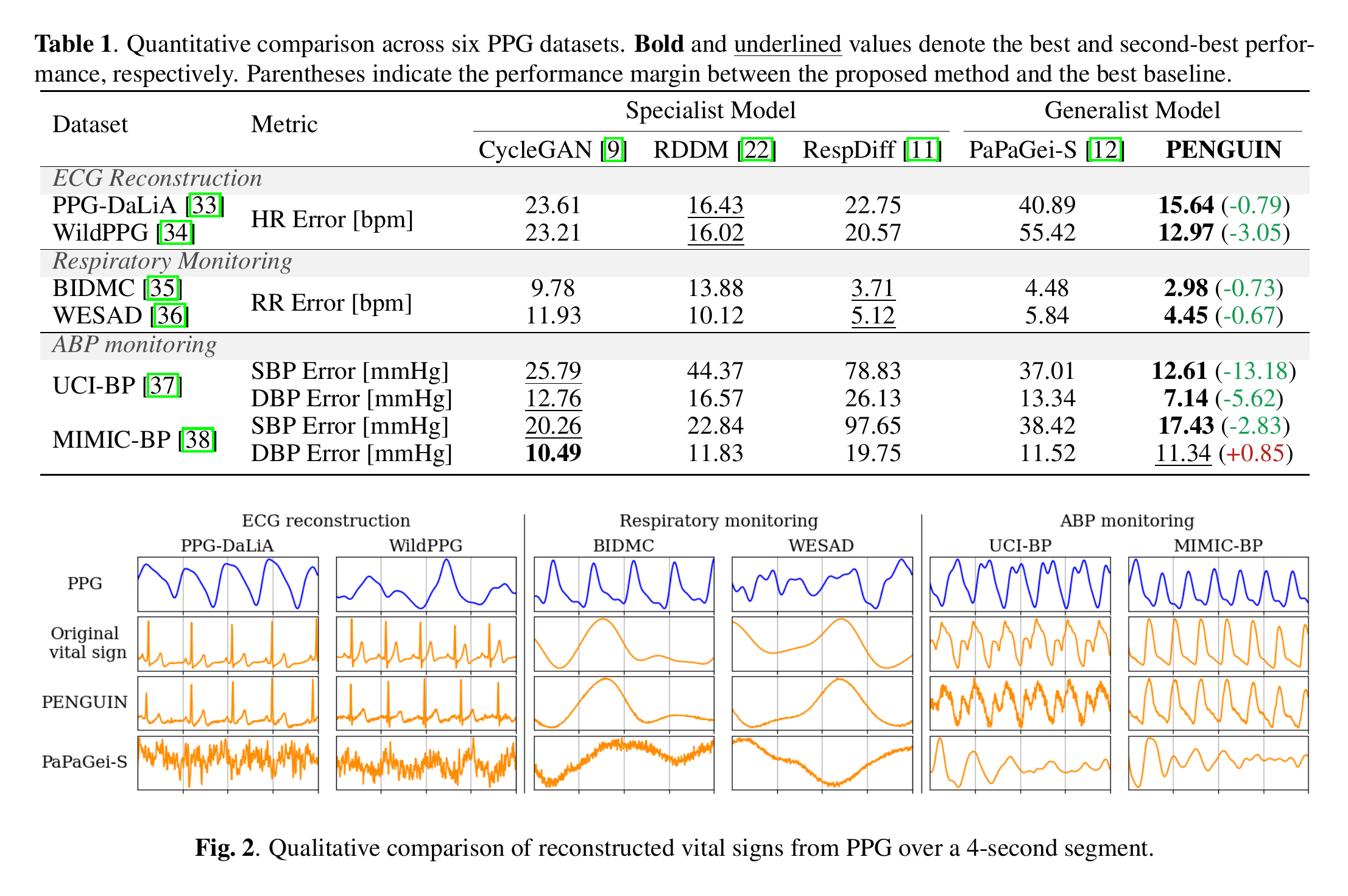
Across ECG reconstruction (PPG-DaLiA, WildPPG), respiratory monitoring (BIDMC, WESAD) and ABP monitoring (UCI-BP, MIMIC-BP), PENGUIN was compared against both task-specific specialist models and general-purpose models. It achieved the best accuracy on 7 of 8 metrics, with especially large error reductions in blood pressure. The reconstructed waveforms faithfully reproduce sharp ECG peaks and respiratory rhythms that differ from the PPG periodicity — a difference that is visually clear against generalist baselines that predict discrete values.
Why it matters
From the PPG that everyday wearables already capture, toward waveform-level vital signs that used to require dedicated medical equipment: PENGUIN handles that conversion in a single model, forming a foundation for non-invasive, continuous health monitoring. It is at the core of our AI research on biosignals in the medical and healthcare domain.