
DecompSSM: A Decomposition-Based State Space Model for Multivariate Time-Series Forecasting
DecompSSM is a multivariate time-series forecasting model developed at Neurogica. It was accepted at ICASSP 2026, a top conference in signal processing, and achieved the best accuracy in 28 of 32 settings across four standard benchmarks spanning electricity, weather and traffic. This research is the technical foundation of our time-series foundation model work.
Why forecasting is hard
Whether it is electricity demand, weather or equipment sensors, a real-world series is never a single motion. A slowly moving trend, cycles repeating by day or week, and irregular residuals that belong to neither: what we observe is a mixture of components with different natures.
Prior work has approached this mixture in three ways. Fixed rules such as moving averages miss whatever does not fit the rule. Learning a decomposition in latent space lacks structure specialised to each component. Isolating periodic parts in preprocessing detaches the decomposition from training, so it can never be tuned for forecast accuracy.
The shared limitation: the decomposition and the forecaster were never optimised end to end, with structure matched to each component.
The design
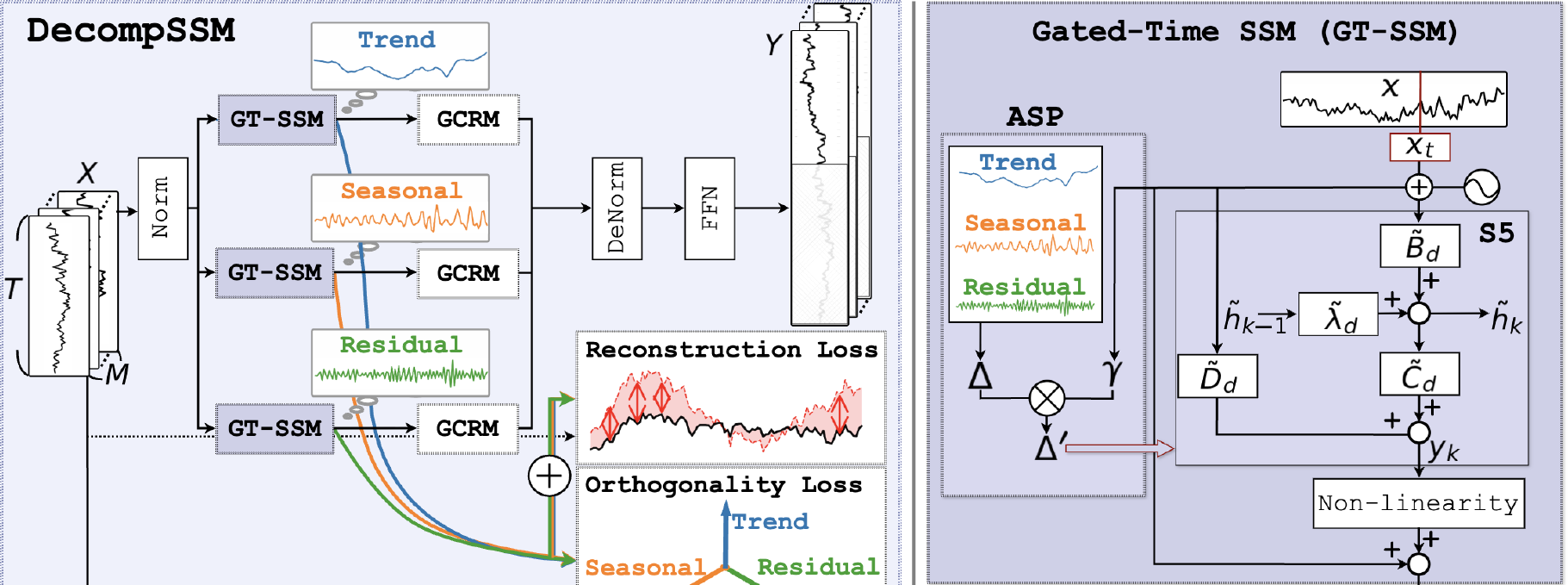
DecompSSM turns the decomposition itself into the model's architecture. Three parallel branches take charge of trend, seasonal and residual components, and the whole model is trained end to end. Three mechanisms carry the design.
A timescale per component. Each branch is a Gated-Time SSM (GT-SSM), a state space model with an Adaptive Step Predictor that modulates its own temporal resolution from the input. The trend branch reads the series slowly and coarsely; the residual branch quickly and finely. Activations and timescale priors are also set per component, encoding the band structure of smooth trends, quasi-periodic cycles and sparse, high-frequency residuals.
Re-synchronising variables. Processed in isolation, variables accumulate mismatches in scale and timing, and noise or missing data pushes components out of alignment. The Global Context Refinement Module (GCRM) aggregates shared context across variables and feeds it back to each one as a residual correction.
A loss that guarantees the decomposition. Auxiliary terms require that the three components add back up to the input (reconstruction) and do not overlap with each other (orthogonality). The decomposition is enforced as a training objective rather than left as a plausible-looking artefact.
Results
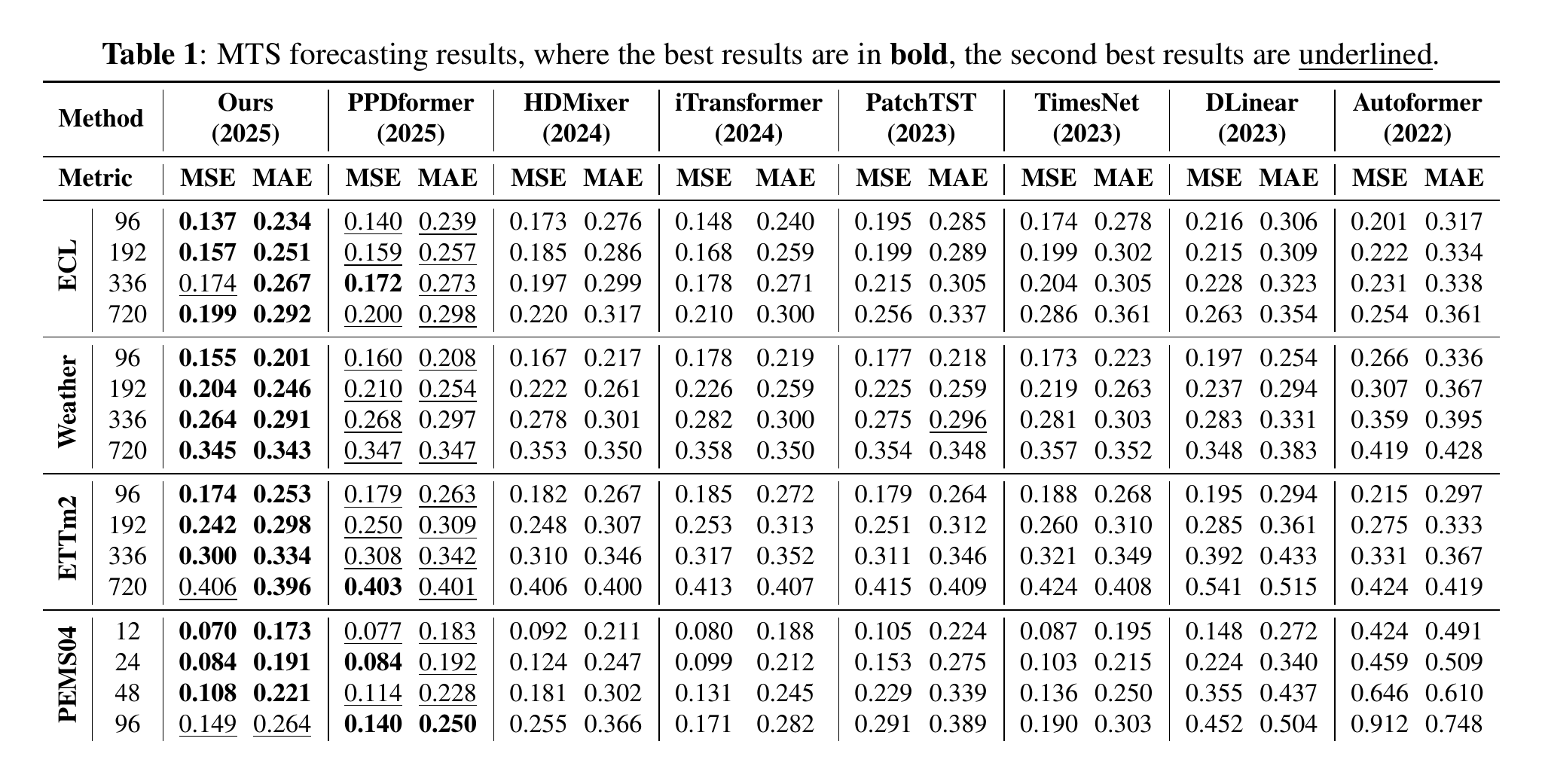
We compared against seven representative baselines, including Transformer-based, linear and convolutional models, on four standard benchmarks: electricity consumption (ECL), weather, transformer temperature (ETTm2) and traffic flow (PEMS04). DecompSSM achieved the best score in 28 of 32 settings; averaged over horizons it improved on the runner-up PPDformer by 2.2% MAE on ECL, 2.3% on Weather and 2.6% on ETTm2.
Ablations showed the largest degradation when removing the GT-SSM branches, confirming component-wise timescale adaptation as the core of the accuracy. Replacing the sequence backbone with Attention, Mamba or Mamba-2 also degraded performance, indicating that S5, whose MIMO parameterisation models cross-variable dependencies explicitly in the state transition, is particularly suited to multivariate forecasting.
What it means
Trend, seasonality and residuals are not industry-specific. The same structure appears in power, finance, healthcare and logistics. Adapting the timescale per component is groundwork for handling time series from different fields in one model, and our foundation model programme builds directly on it.
The paper lists automatic determination of the number of branches from frequency bands as future work. Once the granularity of the decomposition itself can be learned from data, the framework extends further into general signal processing.